
Objective
This blog explains what moving insurance usually covers in Ontario, what it often does not cover, and what homeowners and renters should check before moving day. The goal is to help people understand the difference between a mover’s basic liability, added valuation coverage, and their own home insurance. Ontario also requires written estimates for moving contracts, and in most cases, a mover cannot charge more than 10% above the estimate unless extra work was approved.
Key Takeaways
- A mover’s basic protection is usually limited and may not pay full replacement cost.
- In Ontario, basic liability for household goods is commonly limited to $0.60 per pound per item under provincial conditions of carriage.
- Your home or tenant policy may help with catastrophic loss, but you still need to confirm the details with your insurer before the move.
- Added valuation or replacement protection can offer better coverage, but it still comes with rules and limits.
- A written estimate matters because it helps protect you from surprise charges.
Table Of Contents
- Why Moving Insurance Confuses So Many People
- What Basic Mover Coverage Usually Includes
- What Added Coverage May Include
- What Moving Insurance Often Does Not Cover
- Why Your Home Insurance Still Matters
- Questions To Ask Before You Sign
- Final Thoughts
- FAQs
Why Moving Insurance Confuses So Many People
A lot of people hear the words “moving insurance” and assume everything in the truck is fully protected. That is usually not true.
In Ontario, what many movers offer by default is not full insurance in the everyday sense. It is often basic liability or released value protection. That means the mover may be responsible only up to a limited amount if something is lost or damaged. For household goods, that basic liability is commonly limited to $0.60 per pound per article under provincial rules.
That is why a heavy, low-value item may be covered better than a light, expensive item.
If you are moving with Kapoor Moving Services or any other Ontario mover, it is worth slowing down and reading the paperwork closely before you assume what is protected.
Whether you’re hiring Kapoor Moving Services or any other local moving company in Ontario, it is worth slowing down and reading the paperwork closely before you assume what is protected
What Basic Mover Coverage Usually Includes
Basic mover coverage is the starting point. In many cases, it is included in the move price.
This basic protection usually means:
- The mover has some liability if your goods are lost or damaged during the move.
- The payout is often based on weight, not true replacement cost.
- The limit for household goods is commonly $0.60 per pound per item in provincial moves.
Here is why that matters.
If a dining chair weighs 20 pounds, the basic payout may be only $12. If a television weighs 30 pounds, the basic payout may be only $18, even if replacing it would cost much more. That is the part many people do not realize until after damage happens. The Canadian Association of Movers gives a similar example: a 100-pound table could settle at $60 under basic released value, even if the real replacement cost is much higher.
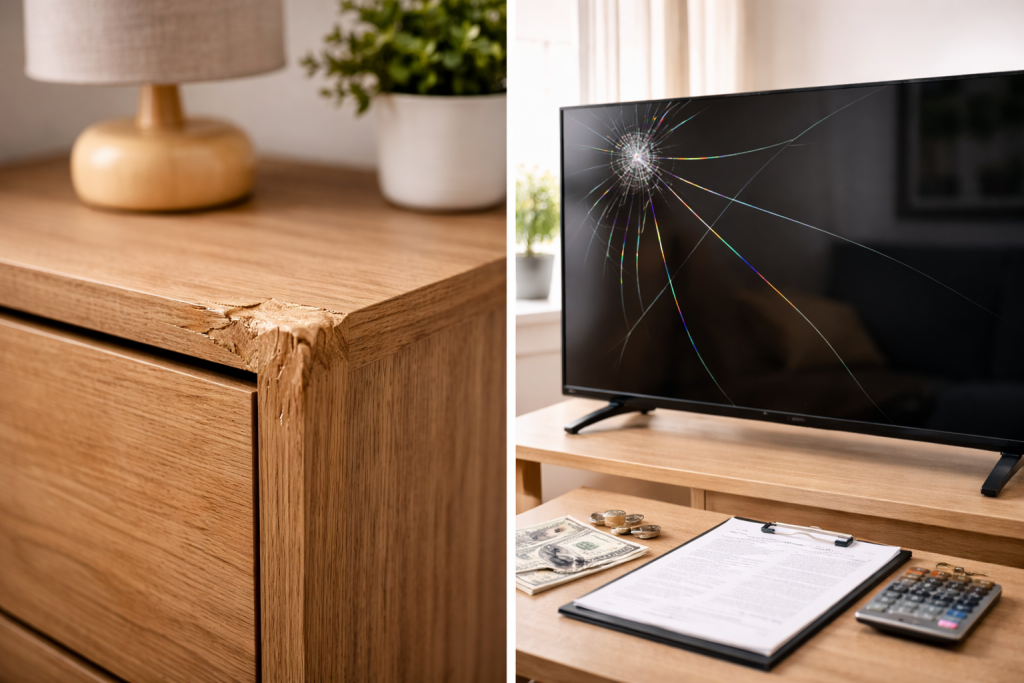
So yes, basic coverage does cover some loss or damage. But no, it does not usually mean full value.
What Added Coverage May Include
Some movers offer stronger protection for an extra cost. This is often called declared value protection or replacement value protection.
That added protection may:
- Increase the mover’s maximum liability
- Offer repair, replacement, or settlement options for damaged goods
- Require you to declare a shipment value before the move
- Come with minimum declared value rules based on shipment weight
The Canadian Association of Movers says replacement value protection is the most comprehensive option and notes that movers can explain how extraordinary-value items should be declared. It also notes that minimum protection for replacement value is often tied to shipment weight, such as at least $10 per pound of total shipment weight.
This is better than basic liability, but it is still not a blank cheque. The contract may still have limits, conditions, deductibles, or special handling rules.
What Moving Insurance Often Does Not Cover
To understand exactly what puts your belongings at risk in the first place, read our guide on
the common causes of furniture damage during moving and how to prevent them.
This is the part people should read twice.
Moving coverage often does not fully cover:
- The full new replacement cost under basic liability
- Items were packed poorly by the customer
- Pre-existing damage
- Losses that were not documented properly
- Very high-value items that were never declared
- Claims made late or without supporting proof, depending on the contract terms and mover policy

The exact exclusions depend on the contract, the type of protection you bought, and the facts of the move. That is why it helps to think of coverage as layered, not automatic.
In simple terms:
- Basic liability helps, but in a limited way
- Declared or replacement coverage helps more, but it still has rules
- Your own insurance may still be needed for a major loss
Why Your Home Insurance Still Matters
A lot of people forget this part.
Canada’s Office of Consumer Affairs says a combination of your household insurance and the mover’s insurance may cover damage or loss during a move, and that household insurance will usually cover catastrophic loss.
That means your own policy may matter a lot if there is:
- A fire
- A major crash
- Theft is tied to a larger insured event
- A total loss situation
But you should never assume your home or tenant policy will automatically handle everything. Policies vary. Some have conditions for moves, vacant homes, storage, jewelry, electronics, artwork, or special collections.
Before moving day, call your insurer and ask:
- Am I covered during transit?
- Are there dollar limits for valuables?
- Does storage change my coverage?
- Do I need a rider or special endorsement?
That one phone call can prevent a bad surprise later.
Questions To Ask Before You Sign
This checklist applies whether you are working with residential movers for a home relocation or any other type of move in Ontario.
Before you hire a mover, ask direct questions.
Use this checklist:
- What basic liability is included?
- Is coverage based on weight or replacement value?
- What extra protection can I buy?
- How do I declare high-value items?
- What exclusions apply if I pack boxes myself?
- What proof do I need if something is damaged?
- How long do I have to report a claim?
- Is the written estimate part of the contract?
Ontario says you should get at least three written estimates before signing. The province also says the mover cannot charge more than 10% above the estimate in most cases unless extra work was agreed to, and that estimate should be part of the contract.
This is also where Kapoor Moving Services should be judged the same way as any mover: by the written terms, not just by verbal promises.
Final Thoughts
Moving insurance in Ontario is not as simple as most people think. Basic mover coverage usually gives limited protection, not full replacement value. Adding valuation coverage can improve that protection, but it still comes with terms and limits. Your own home or tenant insurance may also play an important role, especially in a major loss.
The smartest move is to read the estimate, confirm the contract terms, ask about exclusions, and speak with your insurer before the truck arrives. That is how people avoid wrong assumptions and expensive surprises.
Kapoor Moving Services or any other company should be asked the same clear questions before the move begins.
FAQs
Does Moving Insurance In Ontario Cover Full Replacement Cost?
Not always. Basic mover liability usually does not cover full replacement cost. It is often limited by weight, such as $0.60 per pound per item for household goods in provincial moves. Full or broader protection usually requires added coverage.
What Is The Difference Between Mover Liability And Real Insurance?
Mover liability is the mover’s limited legal responsibility for loss or damage. It is not always the same as full insurance that pays to replace items at today’s cost. That is why many people also check their home or tenant policy.
Will My Home Insurance Cover Damage During A Move?
It may help in some cases. Canada’s Office of Consumer Affairs says your household insurance and the mover’s insurance may work together, and household insurance usually covers catastrophic loss. You still need to confirm the details with your insurer.
Can Movers In Ontario Charge More Than The Estimate?
In most cases, no more than 10% above the estimate unless extra work was approved or the contract changed properly. That is why a written estimate matters so much.
What Should I Do If Something Is Damaged?
Document it right away. Take photos, keep the inventory and contract, and notify the mover as soon as possible in writing. Then check both the mover’s claim process and your own insurance policy.
